


Rozerin Kemanger, member of the Foreign Relations Committee of the East Kurdistan Free Woman Society (KJAR)
The war between the US-Israel coalition and Iran has led to major regional and global developments. Despite the temporary ceasefire, threats by either side and hostilities have continued. In this context of uncertainty, it is important to remind ourselves of one of the main reasons for this war: the goal of global and regional powers to pursue their hegemony in West Asia. The methods of achieving this may change. But the goal to change the regime of the Islamic Republic remains, because it is not in line with the ambitions of international powers. Iran is consequently undergoing profound changes with regards to the regime. This has direct consequences for the redesign of the power balance in West Asia.
Some observers attribute Iran’s weakness solely to the current war. The major impacts of the attacks cannot be denied. But we need to link today’s weakness of the Islamic Republic to the many times before the war when the people, especially women, expressed their dissatisfaction. The policy of the Iranian regime had led to widespread criticism, e.g. with regards to the suppression of voices in support of freedom, the violation of human rights, especially women’s, the increase in executions, and the support for proxy forces abroad. The economic, social and political situation in Iran is dire. A great distance exists between regime and society today.
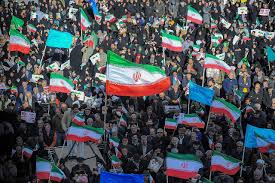
In recent years, the people of Iran have played a leading role in creating transformations. Every time they took to the streets, the regime got weaker. The most striking example was the “Women, Life, Freedom” uprising in 2022/23. The people voiced their demands peacefully and expressed their unity. What did they, led by women, demand? Human rights, protection of existence, freedom, and recognition of the rights of all peoples. But what did the regime do in response? It used brutal violence and thousands were arrested. During the recent war, the state forces once again carried out threats and attacks against the opposition, especially the Kurdish people. The Iranian president used words like Khomeini, the first leader of the Islamic Republic, at the beginning of the 1979 revolution: “We are not fighting the Kurds, we are fighting the infidels.” What did the Kurdish people do in response? They increased their organization, based on the democratization of Iran and the peoples’ coexistence. All this leads to a crucial question: How much does the regime actually want to solve the problems of society, especially those of women?
In recent years, the people of Iran have shown repeatedly how high their political awareness is. Instead of being turned into victims, they chose to make their own decisions in sensitive times, especially the Kurds. But the Islamic Republic has carried out violent attacks, especially in Kurdistan, during the recent war. Why? Because the Kurdish people have a clear democratic project and are well organized. The people of Iran raised the slogan “Kurdistan, Kurdistan, the eyes and the light of Iran” all over the country during the “Women, Life, Freedom” revolution. They did so for a reason. Because they expect the Kurdish people to play a pioneering role based on their project for a decentralized, democratic and unified Iran.
During these times of uncertainty, it is important to be aware of the different scenarios for the coming months and years, the most likely ones being:
1. The current negotiations might fail. If the war continues, Iran’s economic infrastructure will be severely damaged. A security vacuum will increase which can create opportunities for Iran’s social opposition. But everybody is aware of the experience in other West Asian countries, e.g. Syria, Iraq and Afghanistan. In case of a government collapse, managing the transition phase will be the main challenge. Here, the Kurdish opposition, due to its political organization and historical experience, can be an effective actor in East Kurdistan/Northwest Iran to maintain stability and establish a democratic model.
2. A deal between the United States and Iran might be reached and lead to serious threats to the social movement. International powers have often put their strategic interests ahead of democracy and human rights. In this case, the Iranian government is likely to resort to domestic repression to compensate for its international setbacks. This would create a weak and unstable government and a country in which the economic crisis and protests continue, but the tools and instruments of state repression still work. The regime has often used small diplomatic successes as an opportunity to internally suppress the people. While showing softness abroad, it carries out violence at home.
3. One of the main actors in these developments are the country’s social forces. The weakening of the regime has already led to a vacuum. International powers are trying to take advantage of this. But Iran’s society can make decisions on its own instead of counting on outside forces to act. The sexist, nationalist, and extremist policies of the government have only led to war and instability. Society rejects such policies, clearly demonstrated during the “Women, Life, Freedom” uprising. Under all circumstances, the social forces of Iran will therefore protect the people’s interests and remain an important actor. As KJAR, we are prepared for all scenarios. We continue to insist on the democratization of Iran and the common life of the peoples, together with all forces that support freedom, especially women’s organizations. The “Women, Life, Freedom” revolution constitutes an important experience for all of Iran. Our work among our people and together with Iran’s diverse society will continue accordingly under all circumstances. We believe that society can determine its own path. It is legitimate for the social forces to take advantage of opportunities that serve democracy, freedom and unity. However, society should always be careful not to cater to outside powers when it frees itself from a repressive regime. We have learned how to work for our freedom without becoming instruments of foreign powers. This is the right path for social and historical struggles.